09 March 2020

Remembering F. G. Stephens

Rebecca Clara Dalton Stephens and Frederic George Stephens, 1890s, by an unknown photographer. Image courtesy of the Colonel Stephens Railway Museum, Kent.
Frederic George Stephens, the Pre-Raphaelite artist, art critic, art historian, and sometime poet and model, died on this day in 1907, aged 79.[1] In this post I will tell you some lesser-known things about his life and work, which I discovered while researching my PhD thesis on him.

Alphonse Legros, F. G. Stephens, 1889, silverpoint, location unknown, published in J. B. Manson, Frederick [sic] George Stephens and the Pre-Raphaelite Brothers (1920). Stephens and Legros were close friends, and the former wrote reviews of the artist's work.
Stephens photographed by Frederick Hollyer, ca. 1890, published in Hollyer's Portraits of Many Persons of Note, Victoria & Albert Museum, London.

A day on the water


One of Stephens's favourite pastimes, when he wasn't painting, reading, writing or visiting museums and country houses, was rowing. He rowed all his life. I don't know exactly when he first took up this hobby, but it comes up a lot in his early correspondence (late teens, early 20s), inviting his Pre-Raphaelite friends – William Michael Rossetti, the Tupper brothers, Holman Hunt, Rossetti – for leisurely jaunts down the Thames. Sometimes they'd accept, other times gracefully decline. In one letter (I can't now find the exact date) he mentioned having fallen out of the boat into the water during one of these merry excursions – given the state of the river water in those days, lord knows what that felt like!

Why rowing? My theory is that, because of Stephens's lame leg,[2] it was an outdoor physical pursuit which didn't require him to use his legs as much – rowing is more of an upper-body activity. He also evidently found the practice of rowing immensely relaxing, and being out on the water gave him time and space to think, away from the relatively cramped home which he shared with his family. He wrote at least two prose pieces influenced by his rowing habits: 'A Night on the Water', published in an obscure journal called Titan in 1859; and its sequel 'A Day on the Water', which appeared in Macmillan's Magazine in 1864. They are strange things that are hard to categorise: part historical essay, part moody prose poem. Stephens describes the historical locations and heritage sites seen along the banks of the Thames from the rowboat, but also the natural sights around him: 'The day is fresh and brisk with a constant air [...] It is river and sky, sky and river, white cloudlets like swans among the grey'.[3] I need to look into them more!

In 1866, after Stephens married Rebecca Clara Dalton, the couple took up a lease on 10 Hammersmith Terrace, the garden of which backs into the Thames:

View of Hammersmith Terrace from the River Thames. Source.
One of the main reasons why Stephens was attracted to the house was because it allowed easy access to the water. He had his own rowboat which he kept moored at the end of the garden; in one or two letters he mentions having to get it repainted. This stretch of the Thames is also a prime spot for viewing the annual Oxford and Cambridge Boat Race – an event which Stephens followed with interest (the first race was in 1829). He would invite friends and relatives to come around and watch the race from the upper windows of the house, which gave an unrestricted view of the river. One vivid letter by Clara Stephens to her husband not long after their marriage gives an account of her running the household during the boat race while he was away on research, and a stream of visitors arriving to watch the boats from the bedrooms.

'A very prepossessing head'


It's no secret that Stephens was a favourite male model of the PRB. William Michael Rossetti wrote to his mother Frances in September 1849: 'Stephens has, as you say, a most pensive and, I think, very prepossessing head. Millais is painting him for Ferdinand listening to Ariel'.[4] What's telling here is the phrase 'as you say', suggesting that Frances Rossetti too found Stephens good-looking; his physical attractiveness was recognised by both men and women (neither of whom, in this case, were professional artists, and one of whom wasn't even a member of the Brotherhood). Millais's Ferdinand is a faithful likeness of Stephens, when compared with a photograph of him taken in 1859:

John Everett Millais, Ferdinand lured by Ariel, 1849-50, oil on canvas, 65 x 51 cm, The Makins Collection, USA. Source.
F. G. Stephens photographed by Joseph Cundall, 1859, published in Jeremy Maas, The Victorian Art World in Photographs (1984)
Stephens also sat for the central figure of Christ in Madox Brown's Jesus washing Peter's feet:

Ford Madox Brown, Jesus washing Peter's feet, 1852-6, oil on canvas, 116.8 x 133.3 cm, Tate, London. Source.
Ford Madox Brown, Study of F. G. Stephens for 'Jesus washing Peter's feet', 1852, pencil on paper, 29.2 x 34.3 cm, Tate, London. Source.
Curiously, according to Holman Hunt, Brown painted Elizabeth Siddall's hair onto Stephens's head in the final painting!

But these appearances by Stephens in some of the most iconic Pre-Raphaelite paintings are all familiar by now. During my research I looked for any studies or likenesses of Stephens which have been overlooked. It is known that Stephens appears as one of the snobbish, murderous brothers sitting at the dinner table in Millais's Isabella of 1848-9:

John Everett Millais, Isabella, 1848-9, oil on canvas, 103 x 142.8 cm, Walker Art Gallery, Liverpool. Source.
The smiling figure beside Stephens with light-brown hair is usually thought to be Walter Howell Deverell
Stephens is shown holding up a wineglass and chewing his fingernails. Thanks to Millais's meticulous, semi-photographic painting techniques, we can be sure that we are looking at a realistic representation of Stephens's delicate hands and handsome profile (Stephens himself later wrote that the PRBs painted their human models 'exactly, and so to say, to a hair').[5]

I found a study for this painting now in Birmingham Museums & Art Gallery which shows yet another likeness of Stephens:

John Everett Millais, Studies for 'Isabella', ca. 1848-9, pencil on paper, 25.1 x 35.4 cm, Birmingham Museums & Art Gallery. Source.

This study shows that Millais added the fabulous medieval hat later on; he initially sketched Stephens simply, in profile. About a year later, Millais would use Stephens as a model again for Ferdinand.

We don't often allow ourselves to acknowledge that the male models in early Pre-Raphaelite paintings are handsome or even beautiful – we have typically reserved those perceptions for the women, like Siddall, Anne Miller and Fanny Cornforth. Stephens is a useful starting point for considering these issues, which I would like to consider in greater detail in my future research.

'This morning we got to Louvain and tomorrow to Brussels'


Stephens's art history books aren't read much (if at all) nowadays; indeed, you'd be forgiven for forgetting that he was an art historian. But art history was as important to him as his criticism, which engaged with modern art and exhibitions rather than the art of the past. He was a self-taught historian, having not had the Oxbridge education of someone like John Ruskin, and he was equally as interested in researching art as making it while he was a student at the Royal Academy (which had an excellent library). In the 1860s Stephens was finally able to travel to other European cities in order to immerse himself in the original works of art and architecture which he had previously only seen as engravings in books.

A notable example is the trip he made to Belgium while researching his book Flemish Relics in the spring of 1865:

Front cover of Flemish Relics by F. G. Stephens, 1866. Source: Internet Archive.
He was accompanied by the photographer Joseph Fleming, who was enlisted to take photographs of the major public buildings in Brussels, Bruges, Ghent and Antwerp which would be included in the book (luxuriously, as actual photographic prints stuck onto the pages). In May 1865 Stephens wrote to his stepmother Dorothy from the Hôtel le Panier d'Or in Bruges, the first stage of his journey: '[we] found this inn which is in the market-place, right opposite the famous Belfry of nearly 300 feet in height, we have seen several of the places it is necessary to see and shall see the first tomorrow'.[6]

A few days later he and Fleming were in Mechelen, having already passed through Ghent, Oudenaarde and Antwerp; 'this morning we got to Louvain [Leuven] and tomorrow to Brussels, after that it is uncertain where we shall be'. In the same letter he wrote appreciatively about the bells of St Rumbold's Cathedral in Mechelen: 'The carillions [sic] here, and at Audenaerde, are charming, those of this place are playing now some long piece like a waltz tune and very intricate of performance'.[7]

View of Mechlin Cathedral by Joseph Fleming, taken in May 1865, in F. G. Stephens's Flemish Relics.
Stephens's fascination with medieval architecture meant that he opposed what he felt was the over-restoration of historic buildings, particularly churches and cathedrals, in Victorian Britain. He wrote ferociously against the subject in his weekly columns in The Athenaeum – so much so that William Morris wrote to him in March 1877: 'there are many thoughtful people who would be glad to sacrifice time, money, and comfort in defence of those ancient monuments'. Morris had plans for establishing a society 'to keep a watch on old monuments, to protest against all "restoration" that means more than keeping out wind and weather', and he asked for Stephens's help in getting the project off the ground: 'I am unskilled in organising this sort of thing; is it too much to ask you to do something to help, and when could I see you about it?'[8] This led to the founding of the Society for the Protection of Ancient Buildings ('Anti-Scrape') later that year. Stephens's role in the establishment of the society has not been properly acknowledged before, although of course he was not the only person involved.

Funeral


Me standing beside the grave of F. G. Stephens, 3 January 2020. Photo by Felipe Corrêa.
In January I paid a visit to Brompton Cemetery in London, where Stephens and five members of his family are buried. These others are: his father, Septimus Stephens; his stepmother, Dorothy Mary Stephens (née Farmer); his sister, Eliza Stephens; his wife, Rebecca Clara Stephens (née Dalton); and his son, Lt Col Holman Fred Stephens, the last to be buried in this plot.

Stephens's funeral took place on 14 March 1907. It was reported in the Illustrated London News on 23 March:


As the article notes, at his death Stephens was one of the last surviving members of the PRB, the others being W. M. Rossetti and Holman Hunt (from whom Stephens had long been estranged following a string of increasingly unpleasant disagreements). Stephens's youthful association with the Brotherhood determined the course of the rest of his life, having a lasting influence on how he created, researched and wrote about art. There's a wonderful quote from a letter to W. M. Rossetti which I always like to use. It was in 1899, only a few years before his death: 'By the inner principles of P[re]-R[aphaelit]ism my life has been & is still guided'.[9] Although Stephens and his work fell into relative obscurity after his death – at least when compared with his more famous Pre-Raphaelite friends, Millais, Hunt, Rossetti and co. – it was the aim of my PhD and resulting publications (the first of many, I hope!) to turn this around. I close with this memorial from the only 'book' (of sorts) to have ever been published about him, exactly 100 years ago:

My completed PhD thesis!

Notes

[1] Stephens was born on 10 October 1827; some sources give 1828, but they are contradicted by Stephens's baptism record, which gives 1827 as his birth year.

[2] In 1837, while still a child, Stephens suffered an accident which left him with a lifelong limp. The circumstances of this accident are not known. Writing to Madox Brown in 1889, he mentioned having recently hurt his foot, 'badly in the old wound of my boyhood which lamed me for life' (letter from Stephens to Brown, 16 February 1889, National Art Library, V&A).

[3] Frederic George Stephens, 'A Day on the Water', Macmillan's Magazine (1867), p. 227.

[4] Letter from W. M. Rossetti to Frances Rossetti, 28 September 1849, in Roger W. Peattie, Selected Letters of William Michael Rossetti (1990), p. 9.

[5] Frederic George Stephens, Dante Gabriel Rossetti (London: Seeley and Co., 1894), p. 17.

[6] Letter from Stephens to his stepmother Dorothy Mary Stephens, 23 May 1865, Colonel Stephens Railway Museum, Tenterden, Kent.

[7] Letter from Stephens to his stepmother Dorothy Mary Stephens, 29 May 1865, Colonel Stephens Railway Museum, Tenterden, Kent.

[8] See Norman Kelvin, ed., The Collected Letters of William Morris (Princeton, NJ: Princeton University Press, 1984), vol. 1, pp. 351-52 and p. 356, for Morris's letters to Stephens.

[9] 3 August 1899, University of British Columbia Library, Rare Books and Special Collections Division, Angeli-Dennis Collection.

08 March 2020

'Sunshine': Remembering Clara Stephens

Note: The information in this post is derived from my PhD research into F. G. Stephens; more is available in my completed thesis, now with Oxford Brookes University.

As women in the Pre-Raphaelite circle go, Rebecca Clara Stephens (née Dalton) has been more overlooked than others. On International Women's Day, it feels appropriate to call attention to this forgotten woman who was affectionally nicknamed 'Sunshine' by her husband, Frederic George Stephens.

Clara Stephens (with fabulous hat) photographed by William Housley, probably September 1873, Musée d'Orsay, Paris (album of photographs of the family and friends of Lawrence Alma-Tadema). Source.
Her marriage to Frederic has had a knock-on effect over time: the husband was overlooked by scholars, so the wife remained even deeper in the shadows. Their marriage, like any other, had its highs and lows, but it was stable and happy – which doesn't fit the template of the tumultuous, 'bohemian' relationships of the other Pre-Raphaelites which audiences often like to hear about (looking at you, Rossetti). Everyone loves a scandal, but with Clara and Frederic there was little in the way of that – indeed, Frederic deplored the way people gossiped about their relationship in the early 1860s, prior to their marriage. In her memoir about the Victorian art world, Jane Allen Panton (née Frith) recalled seeing the couple often at the London exhibitions in the 1890s:
Mr. Stephens was a man one always saw at all of the Private Views, and no doubt elsewhere […] He wore his hair very long, and was usually attired in a wide ‘artistic’ hat and cloak, while his wife, in an old-fashioned bonnet and shawl, accompanied him and looked after him in a manner touching to behold. He was very lame and plain, and we, as young people, looked upon him as the old gentleman himself, and believed the lameness came from an ill-concealed cloven hoof.[1]
Clara and Frederic George Stephens photographed in May 1894, image courtesy of the Colonel Stephens Railway Museum.
But what about the woman herself?

She was born, evidently, in 1832 in Iver, Buckinghamshire[2] – I say evidently, because when she married Frederic in 1866 she said she was 32 years old, which would mean she was born in 1834. Furthermore, her death certificate in 1915 gives her age as 85, which suggests a birth year of around 1830. Nineteenth-century registers are notoriously unreliable, so perhaps we shouldn't rely on them too much. At any rate, little is known about Clara's early life, making her upbringing and education difficult to pin down. Her parents were Riley and Sarah Dalton. The 1861 census shows them living in Eagle Cottage in the parish of St Mary the Boltons, West Brompton, with their three sons, Clara's brothers: Samuel (aged 23), John (19) and William (16). They were working class: Riley was a building contractor, Samuel was a carpenter and her other brother John was a ‘carman’. In 1851, Clara was working as a servant, aged 18, in the house of Gilbert-Louis Duprez, a notable French tenor, in Albert Place, Kensington.[3]

I have no space here to discuss the mysteries surrounding Clara's two children born in the 1850s, Clara Adelaide Charles (nicknamed 'Lottie) and 'Charlie'. At this time Clara was evidently married to a man named William Charles, the father of Clara and Charlie, although the circumstances are shadowy and require further research – a good subject for a future post!

Decorated card by Clara Stephens to her husband Frederic, 1897, image courtesy of the Colonel Stephens Railway Museum, Tenterden, Kent.
Another mystery is exactly how and when she met Frederic George Stephens. There is a touching card decorated by her and given to her husband in 1897, 'In remembrance of a windy May morning in Cheny [sic] Walk 1859' (pictured above) – evidently an event of some significance for the couple, and an indication that they knew each other as early as 1859. At that time, Clara was a student at the National Art Training School in South Kensington – another aspect of her life that needs more research. Her early letters to Frederic occasionally mention her art lessons, such as in July 1861: 'I know darling it will delight you to hear of any thing that I have done well, after all the time that you have spent for my advantage[,] they gave me an apple to shade and Mr Slocomb said it was very well done'.[4] However, it seems very little of her work, if anything, has survived.

Handwriting practice by Clara, in the Colonel Stephens Railway Museum, Tenterden, Kent.
A distinctive characteristic of Clara and Frederic's relationship in the early 1860s is that Frederic became obsessed – too much so, in my opinion – with improving her handwriting, spelling and grammar. There are many letters exchanged between them on this matter. Pictured above is an example of the handwriting exercises which Frederic sent to her: she had to copy the words 'seventeen', 'near', 'marry', 'altho[ugh]', 'forty' and 'manner' repeatedly in order to improve her cursive lettering.

Frederic George Stephens, Rebecca Clara Stephens (née Dalton), ca. 1860s (1866?), watercolour and gouache on paper, 40 x 34.1 cm, collection of Dennis T. Lanigan.
Frederic painted this watercolour portrait of Clara some time after they met; it's undated, but it could have been made around the time of their marriage on 6 January 1866, as a sort of love token. The peacock feathers in her hair could be a reference to the contemporary Aesthetic Movement.

Lawrence Alma-Tadema, Rebecca Clara Stephens (née Dalton), 1873, oil on panel, 11 1/4 x 16 inches, location unknown. Reproduced in J. B. Manson, Frederick George Stephens and the Pre-Raphaelite Brothers (1920). Source.
Clara also sat to Lawrence Alma-Tadema – a close friend of the Stephenses – for this portrait in 1873, which sadly is now untraced.

Clara was very much in love with Frederic. During my PhD research, I read through many of her letters in the Colonel Stephens Railway Museum, in which she pours out her heart to him. When, in September 1866, they moved into their first proper home, 10 Hammersmith Terrace, Clara enjoyed playing the role of hostess to Frederic's circle of friends. She enters suddenly into the Pre-Raphaelite social scene, mentioned affectionately in D. G. Rossetti's letters to Frederic and floating in and out of Frederic's letters to Holman Hunt, W. M. Rossetti and Ford Madox Brown. Apparently, Oliver Madox Brown called her a 'Roman matron' owing to her hospitality and jovial, down-to-earth personality.

Clara and Frederic on holiday in Cornwall, 1890s, image courtesy of the Colonel Stephens Railway Museum, Tenterden, Kent.
In writing this, I realised I have a lot more to say about Clara than I first thought. I would like to write more about her in future, and sometimes a blog post isn't enough. If people are interested to know more, I will certainly continue the subject!

For now, on International Women's Day, let's remember the forgotten women in the shadows behind the famous – or not so famous, in Frederic's case – Pre-Raphaelite Brothers.

Notes

[1] Jane Ellen Panton, Leaves from a Life (London: Eveleigh Nash, 1908), pp. 171–72.

[2] Information found by Philip Shaw of the Colonel Stephens Railway Museum, Tenterden, Kent.

[3] Many thanks to Bob Clifford of the Colonel Stephens Railway Museum for this information (email, 11 June 2018).

[4] Letter from Clara to Frederic, 12 July 1861, Colonel Stephens Railway Museum.

23 February 2020

Rustic (queer?) music

Note: I'm not sure if the comparisons in this post have been made by Leighton scholars before – if they have, my apologies for the oversight!

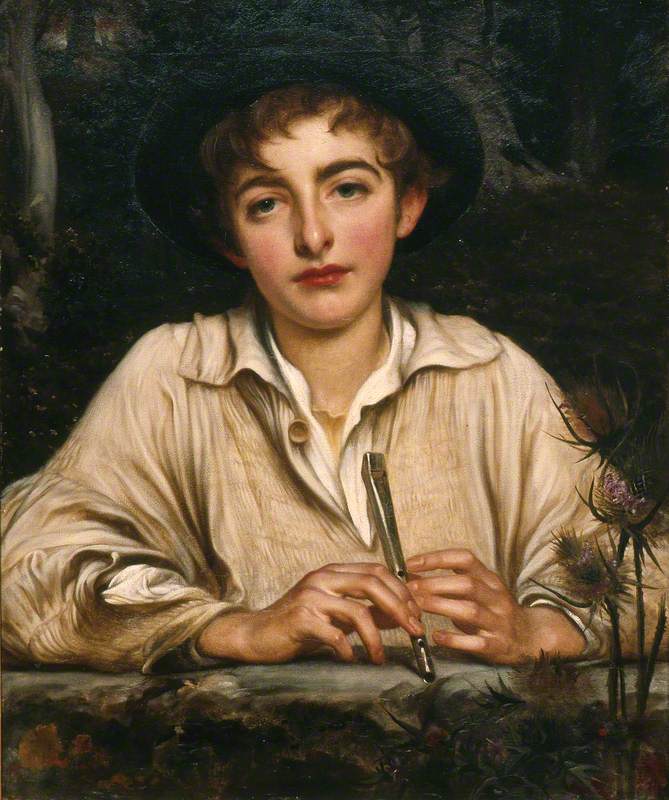
During a visit to Leighton House Museum in the New Year, I saw this painting by Frederic Leighton (1830-96), entitled Rustic music:

Frederic Leighton, Rustic music, 1861, oil on canvas, 109 x 91 cm, Leighton House Museum, London. Source.
The sitter is John Hanson Walker (1844-1933). Walker was discovered by Leighton while he was working in his father's curiosity shop in Bath in the late 1850s. Leighton was struck by his beauty and chose him as a model. (This incident is eerily similar to the legend/fable/myth of Elizabeth Siddall being discovered by Walter Howell Deverell while she was working in a London hat shop.) In 1861 Leighton wrote to his sister: 'I have just returned from a fortnight in Bath, where I have finished the two Johnnies, I believe, and hope you will like them'.[1] The 'two Johnnies' refers to two paintings for which Walker had modelled: one was Rustic music, the other was entitled Duet. Leighton submitted both pictures to the 1862 Royal Academy exhibition, but only Duet was accepted.

Frederic Leighton, Duet, 1861, oil on canvas, 61.2 x 44.7 cm, Royal Collection Trust, London. Source. The painting was given as a birthday gift to Queen Victoria by the Prince of Wales in 1868.
Rustic music and Duet, painted simultaneously, depict near-identical subjects: a youth in an outdoor pastoral setting, wearing the same rustic outfit and holding the same metal flute in both pictures. They contain a suggestion of music – an interest among artists in the 1860s – and seem designed to emphasise the youth's good looks: his full red lips, tousled hair, flushed cheeks and thoughtful eyes. (Walker was around 17 years old when these paintings were made.) Plenty of scholars have speculated that Leighton had homosexual tendencies, although this is difficult to confirm through documentary evidence as he left no diaries behind and he was generally evasive about his personal life.[2] Certainly, he appreciated Walker's beauty enough to paint him, and he subsequently took on the young man as a pupil and studio assistant. We could even describe Walker as Leighton's 'muse' – a role typically assigned to women in heteronormative accounts of nineteenth-century art.

While Duet adopts a different compositional format, it doesn't take much effort to see in Rustic music a clear analogy to Dante Gabriel Rossetti's Bocca baciata, painted around two years earlier in 1859:

Dante Gabriel Rossetti, Bocca baciata, 1859, oil on panel, 32.1 x 27 cm, Museum of Fine Arts, Boston. Source. The model was Fanny Cornforth, one of the most recognisable Pre-Raphaelite models.
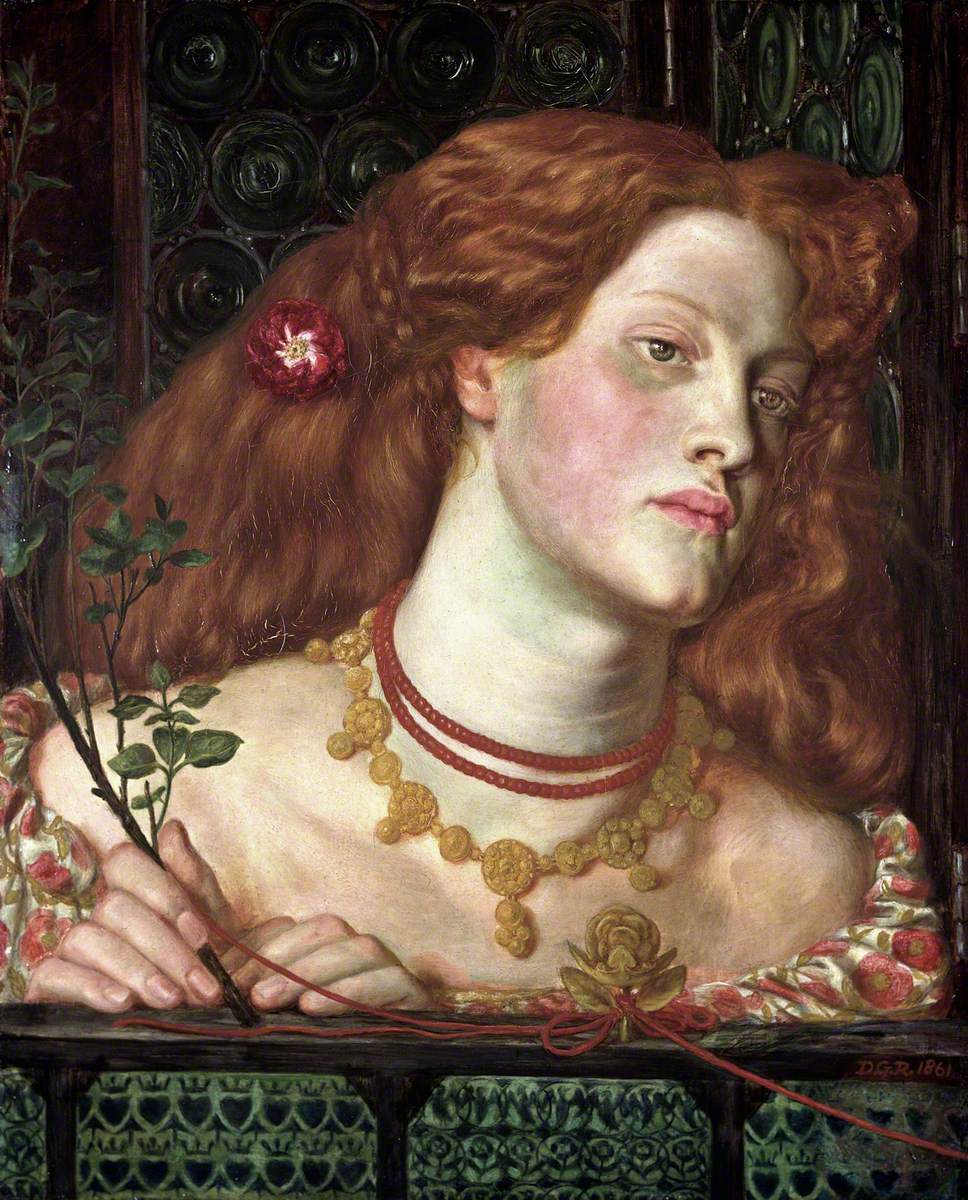
Rossetti exhibited this small picture at the private Hogarth Club, of which Leighton was a member, in 1860 – there is no doubt that he would have seen it. Bocca baciata was the first of many images by Rossetti presenting a single female figure in a bust format with a ledge in the foreground and a compressed background containing flowers or other decorative elements. These are the images for which Rossetti is best remembered, and which have become synonymous with the term 'Pre-Raphaelite' for many viewers. Fair Rosamund, painted in mid-1861, several months before Leighton's Rustic music, continues the device:

Dante Gabriel Rossetti, Fair Rosamund, 1861, oil on canvas, 51.9 x 41.7 cm, National Museum Wales, Cardiff. Source.
Leighton has clearly borrowed Rossetti's pictorial strategy of portraying women for his own painting of a male youth whom he considered beautiful. Rustic music has a shallow ledge in the foreground on which the boy's hands rest. The torso and head are viewed frontally and fill most of the space, with the head cocked slightly to the viewer's left (as in Bocca baciata), and the human figure is surrounded with natural objects – thistles and trees in this case. There is an additional similarity in Leighton's brushwork, which has a soft, luminous quality as in Rossetti's paintings at this time. (Rossetti acknowledged Venetian painting as an influence on Bocca baciata.) Rossetti's women are invariably shown clutching an object which accentuates their slender fingers placed on the shelf before them; the same quality is apparent in the boy's fingers grasping the flute, which have a delicate, dextrous appearance. Like Rossetti, Leighton has used highlights on the fingernails and knuckles to call attention to the boy's preparation to play music.

The suggestion of music in Leighton's picture finds its equivalent in Rossetti's painting made four years later, The blue bower, in which Fanny Cornforth's fingers are about to pluck the strings of her instrument – just as we might imagine the notes which will emerge from the boy's fingers once he raises the flute to his lips.

Dante Gabriel Rossetti, The blue bower, 1865, oil on canvas, 84 x 70.9 cm, Barber Institute of Fine Arts, University of Birmingham. Source.
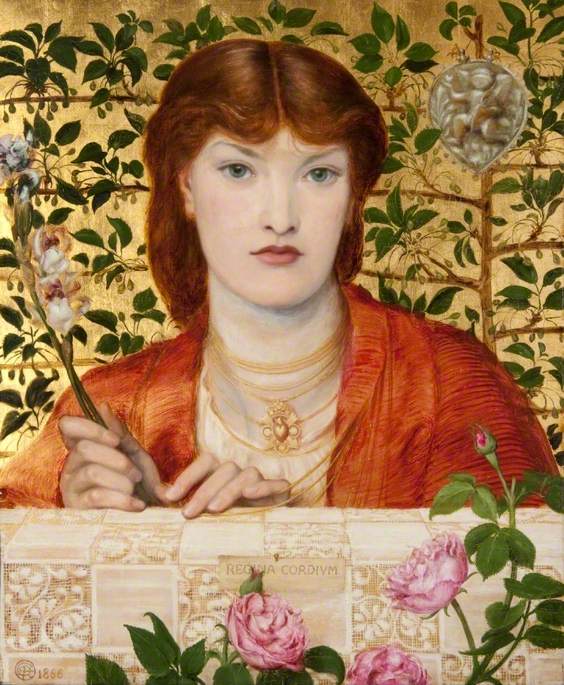
Dante Gabriel Rossetti, Regina cordium, 1866, oil on canvas on panel, 59.7 x 49.5 cm, Kelvingrove Art Gallery and Museum, Glasgow. Source. Another interesting point of comparison with Leighton's Rustic music.
Now, what can we take from this?

We must take care when reading the work of a deceased artist whose sexuality we cannot easily define. Leighton may simply have found this type of composition visually appealing, or he could see how popular (saleable) Rossetti's work in that line was becoming. The fact that Leighton was exploring the idea of transposing a male figure into a typically Rossettian pictorial space, where we would ordinarily expect to see a woman, is insightful in itself. Rustic music is not as clear in its intentions as, say, the work of Simeon Solomon produced contemporaneously in the 1860s, such as the now-famous Bacchus of 1867:

Simeon Solomon, Bacchus, 1867, oil on paper laid on canvas, 50.3 x 37.5 cm, Birmingham Museums & Art Gallery. Image: Birmingham Museums Trust.
Solomon, of course, was persecuted for his homosexuality in 1873, and his works can be more easily read as gay or queer in nature (several, including Baccus, were included in the exhibition Queer British Art at Tate Britain in 2017). Scholars have evidently had more difficulty with Leighton.

Perhaps I'm being too coy. It can be argued that Leighton was examining male beauty in much the same way as Solomon in his Rustic music. That the model, John Walker, was only 17 when it was painted – and he was still a boy when Leighton discovered him – is something we might also take with caution, although there is no evidence to suggest that anything sinister 'went on'. Walker seems not to have minded the older man's attentions, while Leighton supported Walker's burgeoning talents as an artist and painted a fine portrait of Walker's eventual wife in 1867:

Frederic Leighton, Mrs Frances (Nan) Hanson Walker (née Whitaker), 1867, oil on canvas, 46.4 x 41.3 cm, Tate, London. Source. Many thanks to Barbara Bryant for informing me of 'Nan's' proper name!
Given Leighton's central position in the British art world in the 1860s, and his acquaintance with avant-garde theories, it's also reasonable to see Rustic music simply as an expression of the developing Aesthetic Movement, with its lack of narrative and emphasis on music/sound. Earlier in 1861, Leighton exhibited at the Royal Academy his 'Lieder ohne worte' ('Songs without words'), a large, enigmatic painting inspired by Mendelssohn's cycle of piano pieces of the same title:

Frederic Leighton, 'Lieder ohne worte', exhibited 1861, oil on canvas, 101.6 x 62.9 cm, Tate, London. Source.
Hang on, haven't we seen the woman's face somewhere before? In fact, it's that of young Walker – a male figure modelling for a female one. If that isn't queer, I don't know what is.

I don't have any definite conclusions for this post, which arose out of my initial observations after seeing Leighton's Rustic music. But it gets us thinking about male beauty as depicted by men in the mid-Victorian period – a topic which has received relatively little attention in studies of British art. It's a subject I would like to examine more in my research, so this post seemed a good place to begin.

Notes

[1] Quoted in Mrs Russell Barrington [Emilie Isabel Barrington], The Life, Letters and Work of Frederic Leighton (London: George Allen, 1906), vol. 2, p. 85. The letter was probably written in December 1861, owing to a reference to Prince Albert's recent death (on 14 December).

[2] See Richard Norton, 'Fay and Babbo: The Gay Love Letters of Henry Greville to Frederic, Lord Leighton' (2014) for a discussion of this subject.

22 February 2020

Two triptychs

Pedro Weingärtner (1853-1929). Source.
Pedro Weingärtner (1853-1929) was a Brazilian academic painter. He was born in Porto Alegre in the state of Rio Grande do Sul, to German parents who had emigrated to Brazil (hence his German surname). In the late 1870s and 1880s he studied painting in Germany, as the pupil of Ferdinand Keller, and in France, where he was taught by William-Adolphe Bouguereau. Thanks to a scholarship from the emperor of Brazil at the time, Pedro II, he continued his studies in Rome. For the rest of his career he split his time between Brazil and Italy.

Maker of angels


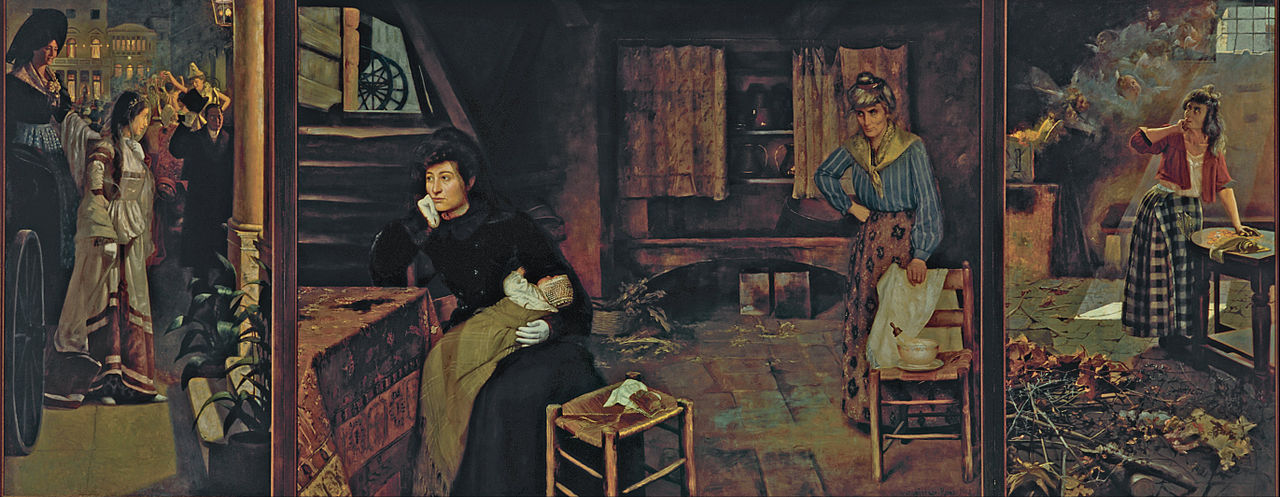
One of Weingärtner's most notable works is in the Pinacoteca de São Paulo (São Paulo's oldest art museum, founded in 1905). Its Portuguese title is A fazedora de anjos, or The maker of angels. Painted in 1908, it was designed as a narrative triptych – divided into three compartments that tell a story when read from left to right.

Pedro Weingärtner, A fazedora de anjos (The maker of angels), 1908, oil on canvas, 151 x 375 cm, Pinacoteca de São Paulo, São Paulo, Brazil. Source.
The story begins:

Two women descend from of a carriage at the entrance of a house. They are dressed for an evening party. The jubilant, costumed crowd behind them shows that this is Carnival season in Brazil (typically February, before Lent). The foremost woman glances at a man who stands in the shade behind the porch; he raises his hat to her in greeting. There is an implied connection between them. Note the man dressed as the Devil who leers at us from behind the top-hatted gentleman.

The large central canvas depicts a room in a basement. The central woman from the previous scene – identifiable by her dark hair, white gloves and veil – now sits at a table, cradling a baby on her lap. Her carriage waits for her at the top of the steps in the upper-left corner – further indicating her status as a high-society woman. She does not look down at her child, but gazes into the distance. We might read her expression as one of regret, or she may be contemplating the decision she is about to make. She does not engage, either, with the other woman in the room, who is older and who regards the young mother with a shifty expression. A clue to this older woman's role can be seen on the chair before her: a cloth, a small bowl and a milk bottle. She is a wet nurse who will be taking the baby off the younger woman's hands. Or is there something more sinister going on? On the stool beside the young mother we notice a small wallet or purse.

The right-hand compartment stages the tragic conclusion to this tale, as the meaning of the triptych's title, The maker of angels, becomes clear. The older woman from the previous scene stands beside a table on which she has emptied a bag of coins. The lit furnace behind her emits a plume of smoke in which the spectral faces of several infants materialise before her eyes. From this we can infer that the young mother, having been seduced by the top-hatted gentleman in the first scene, has paid to have her illegitimate child – the result of that affair – killed by the older woman, who is afflicted by visions of the other innocents she has murdered.

Weingärtner apparently based his triptych on a real event in Brazil, although I was unable to find out more about this. There is a PhD thesis devoted to the painting by Vivian da Silva Paulitsch,[1] but as it's in Portuguese I haven't been able to read it yet – ah, the aforementioned difficulties of studying Brazilian art!

Past and present and 'fallen women'


When I saw Weingärtner's painting in the Pinacoteca de São Paulo, I was reminded of a similar narrative triptych by a British artist: Past and present by Augustus Leopold Egg (1816-65), which is in Tate Britain in London. When it was first exhibited at the Royal Academy in 1858, the work was hung in the following formation from left to right:


All three images: Augustus Leopold Egg, Past and present, 1858, oil on canvas, each canvas 63.5 x 76.2 cm, Tate, London. Source.
John Ruskin summarised the narrative in his 1858 Academy Notes:
In the central piece the husband discovers his wife’s infidelity; he dies five years afterwards. The two lateral pictures represent the same moment of night a fortnight after his death. The same little cloud is under the moon. The two children see it from the chamber in which they are praying for their mother; and their mother, from behind a boat under a vault on the river-shore.[2]
Ruskin does not mention another significant detail in the first picture: the mother under the bridge is sheltering a small child, the result of the seduction, under her shawl – you can just see the feet poking out in the bottom-left corner.

Egg's and Weingärtner's works complement each other, not least because they each tell a story of modern urban life which is divided into three dramatic sections like tableaux on a stage. The way the stories unfold could even be described as cinematic, using flashbacks and narrative cuts. The maker of angels and Past and present concern women who have, in nineteenth-century terms, fallen from grace. The female protagonists have each been 'seduced by a sham count, with a moustache' (to quote Ruskin)[3] and are forced to bear the consequences. I can't tell whether the central woman in Weingärtner's Maker of angels is married – I can't see a wedding ring in the reproductions, but perhaps there are other clues about her marital status elsewhere in the work.

Of course, the outcome of Weingärtner's triptych is far more disturbing than Egg's, in that the child born out of wedlock is eventually killed. Still, both artists prompt us to think about the societal pressures that were placed upon women in the nineteenth and early-twentieth centuries – so that women were cast penniless onto the streets, and infanticide was considered as a legitimate means to prevent destitution. In some ways, we could view The maker of angels as offering a grim solution to the predicament of the mother in Past and present. As Annabel Rutherford has pointed out: 'In Egg's triptych, the fallen woman represents the outcast adulteress who, abandoned with illegitimate child, is left destitute, wandering the streets'.[4] Such a future would face the woman in Weingärtner's Making of angels, which is why she has taken her child to the murderous wet nurse. The two triptychs therefore enact different versions of the same kind of story.

'Mundane and celestial things'


When writing this post, another comparison came to mind regarding the ghostly babies in the final scene of Weingärtner's Maker of angels:

The slaughtered innocents bring to mind William Holman Hunt's hallucinatory The triumph of the innocents, which exists in three versions (I've included the 1883-4 Tate version below). It depicts the souls of the infants slaughtered during the Massacre of the Innocents, which caused the Holy Family to flee Bethlehem into the wilderness, materialising around the family as they cross a river:

William Holman Hunt, The triumph of the innocents, 1883-4, oil on canvas, 156.2 x 254 cm, Tate, London. Source.
There is a tension between naturalistic and supernatural elements co-existing within the same pictorial space – a space which is defined by an obsessive attention to realistic detail. This caused difficulties for Hunt even at the time. As a staunch upholder of Pre-Raphaelite ideals, he believed that a historical or religious subject should be depicted exactly as it happened – a practice which involved making careful studies of figures and landscapes from the material world and synthesising these observations into a cohesive composition. Frederic George Stephens, who had co-founded the Pre-Raphaelite Brotherhood with Hunt decades earlier, published his eloquent critiques of The triumph in 1885, declaring in one article:
We cannot see mundane and celestial things at the same time and on equal terms. Hence the realistic landscape and very human figures are in contradiction with the spiritual essences, and visionary bubbles and globes, and the water which is not of the earth, just as the over-solid forms and substances of the Innocents’ figures themselves set at defiance, so to say, their glorified condition.[5]
Elsewhere, Stephens wrote:
In this respect the picture fails completely, not, of course, through any defect of skill, studies, or power on the part of the artist, but simply because he has employed methods which could not succeed. He has endeavoured to represent spiritual essences with substantial appearances, including the varieties of the form, light, shade, and vivid colouring of the life. Naked figures and flying draperies err alike in this respect, and the very souls of the slaughtered children have substances which would weigh heavily in earthly scales. The glorified Innocents are not only splendidly illuminated by an unaccountable lustre, which casts shadows as strong as those of the sunlight when most powerful, but they shine with inner beams, and are self-radiant, though massive.[6]
We can see the same tension between 'spiritual essences' and 'substantial appearances', between 'mundane and celestial things', occurring much earlier in Pre-Raphaelite art, when Millais painted Ferdinand lured by Ariel in 1849-50. Millais depicts a very lush, very real garden,[7] containing a multitude of plants so carefully studied from nature that they could be identified by a botanist, alongside translucent sprites and the supposedly invisible figure of Ariel whispering in Ferdinand's ear:

John Everett Millais, Ferdinand lured by Ariel, 1849-50, oil on canvas, 65 x 51 cm, The Makins Collection, USA. Source.
What does this have to do with Weingärtner's Brazilian triptych? Quite a lot, I think. Something interesting happens when realist painters introduce unreal or supernatural elements into the midst of their pictures. The pictures no longer fit comfortably into one genre or another, but sit ambiguously between the two. Weingärtner's spectral innocents disrupt or unbalance the social realism of his narrative, which up until this point has been generally concerned with 'mundane' matters. Is the murderer merely imagining the faces in the smoke, or are they actual manifestations? Either way, the woman is haunted – whether by her conscience, or by real ghosts, or both, is left for the viewer to decide.

This post has offered only an introductory glance at these two triptychs.  There are clear stylistic differences between the two, Weingärtner having been more influenced by French art than British art. Egg's Past and present from 1858, and Weingärtner's Maker of angels from 1908 (but still a very nineteenth-century painting in its style and themes), both offer insights into how issues of 'illegitimate' children and 'fallen' womanhood were treated by male painters in Britain and Brazil in the nineteenth and early-twentieth centuries. The maker of angels also allows us to see a supernatural motif accorded the same realism as the human elements of the triptych – a problem which faced the Pre-Raphaelites earlier in the nineteenth century.

Notes

[1] Vivian da Silva Paulitsch, Impasses no exercicio da feminilidade e da maternidade no triptico La Faiseuse D'Anges do pintor Pedro Weingartner (1853-1929) [Impasses in the exercise of feminity and motherhood in the triptych La Faiseuse D'Anges by painter Pedro Weingartner (1853-1929)], PhD thesis, University of Campinas, 2009. There is an English version of the abstract but the thesis itself is in Portuguese.

[2] John Ruskin, Works of John Ruskin, eds. E. T. Cook and Alexander Wedderburn (London: 1904), vol. 14, p. 166.

[3] Undated letter from John Ruskin to Mrs John Simon (probably 1858), quoted in Annabel Rutherford, 'A Dramatic Reading of Augustus Leopold Egg’s Untitled Triptych', Tate Papers, no. 7 (Spring 2007), note 6.

[4] Rutherford, 'A Dramatic Reading'.

[5] Frederic George Stephens, 'New Pictures', The Athenaeum, 7 March 1885, p. 318.

[6] Frederic George Stephens, 'The Triumph of the Innocents', The Portfolio (April 1885), pp. 81-82.

[7] Millais painted the outdoor elements of Ferdinand lured by Ariel in a real garden near Shotover Park, outside Oxford, in the summer of 1849.

15 February 2020

Thoughts on Brazilian art

Me with Pedro Américo's vast canvas The battle of Avaí (1872-9) in the Museu Nacional de Belas Artes, Rio de Janeiro, Brazil, 10 May 2018
How do you begin to study or engage with historical Brazilian art outside Brazil, particularly when you are based in the UK? Immediately there are some problems.

Firstly, there have been very few books on Brazilian art written in English – especially art from the nineteenth century, the period I'm principally interested in. Plenty of books have been published in Brazil, but this requires a working knowledge of Portuguese (which I don't yet have) and access to a library which contains these books in the first place.

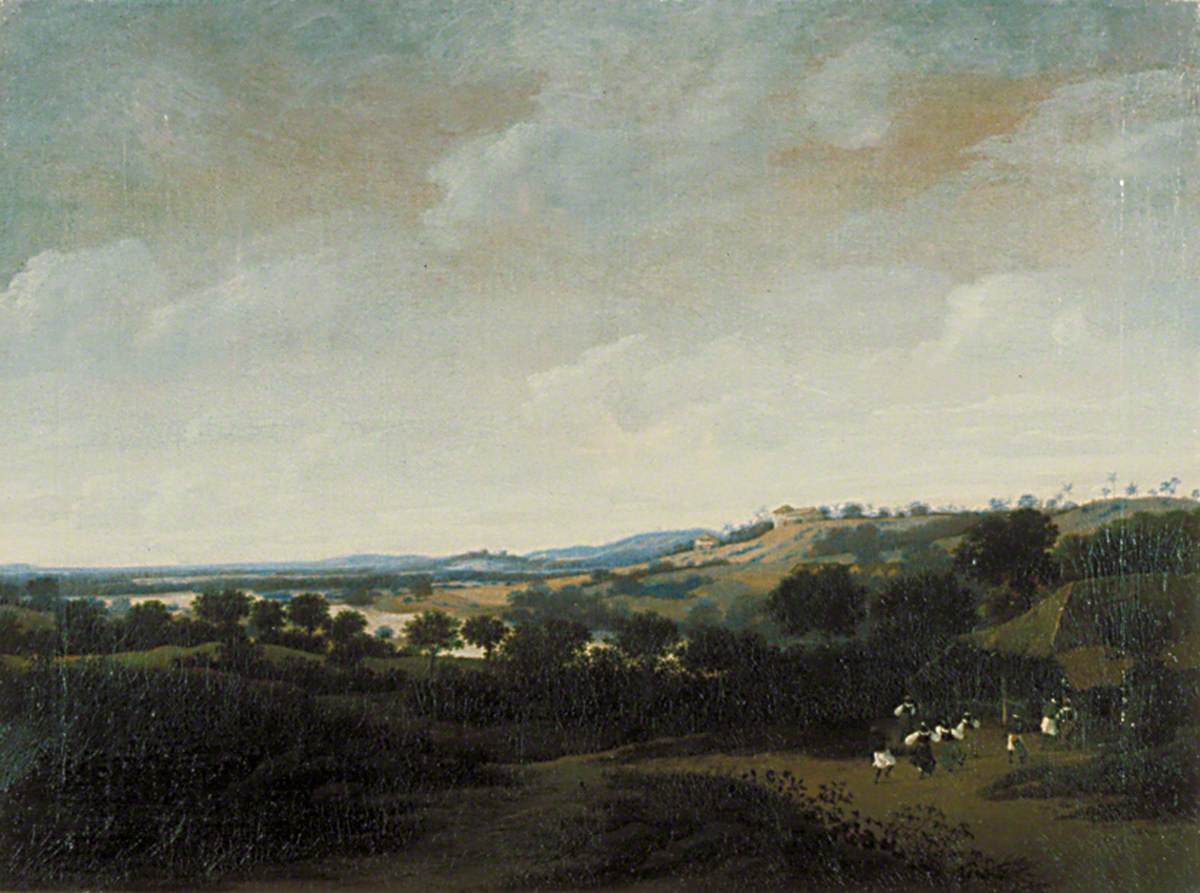
Secondly, there are very few examples of Brazilian art in museum collections outside Brazil – at least in the UK. A search of the Art UK website reveals a dearth of Brazilian artists. Certainly, there were artists who travelled from Europe to Brazil in order to document (and to idealise) the 'New World' and its landscapes and peoples: notable examples include the Dutch painter Frans Post (1612-80) and the British artist and biologist Marianne North (1830-90). Works by these artists are available in London museums, such as this Brazilian scene by Post:

Frans Post, Brazilian scene, ca.1665, oil on 48.7 x 64.7 cm, Guildhall Art Gallery, London
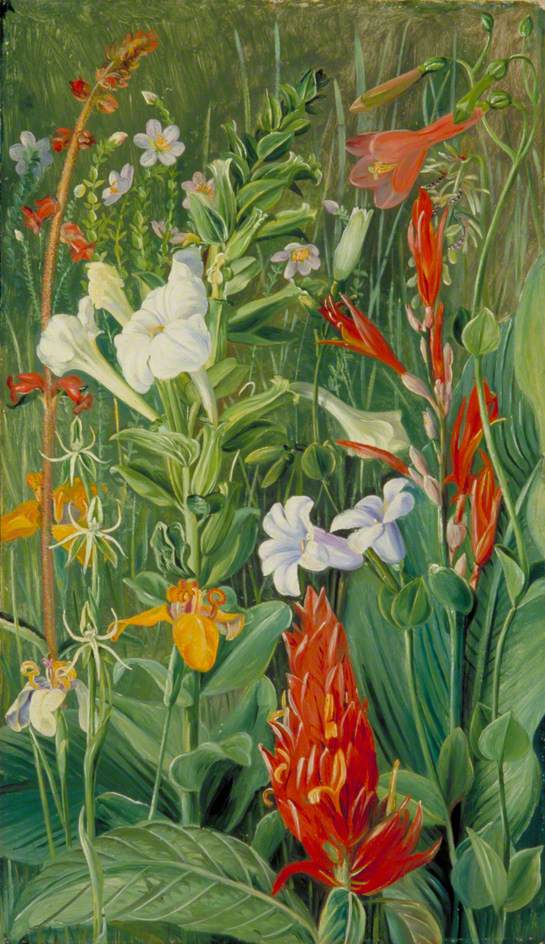
Or this vivid study of Brazilian flowers by North:

Marianne North, Brazilian wild flowers, ca.1873, oil on board, 51 x 29 cm, Marianne North Gallery, Royal Botanic Gardens, Kew  
This leads to the third, historical factor: in the same way that few British artists went to Brazil in the nineteenth century, few Brazilian artists came here, that I'm aware of. Virtually no art by Brazilians was produced in the UK, so it was not commissioned or collected (do let me know of any examples of this).

Fourth, Brazilian art is absent from many art history curriculums in schools and universities, leading to a lack of awareness even among academics. I was lucky enough to attend one of the few state sixth-form colleges which taught art history at A level (Truro College in Cornwall if you're interested). Our textbook was E. H. Gombrich's The Story of Art, which excludes Brazil from its 'survey of the history of art from the ancient world to the modern era'. This carried over into my undergraduate degree, which focused primarily on European painting and sculpture. My view of art history was therefore heavily Eurocentric; like a typical gringo, the only Latin American artist I could cite with any certainty was Frida Kahlo, who wasn't even from South America anyway.

Following on from this, it seems there have been relatively few exhibitions of historical Brazilian art in the UK. The Ashmolean in Oxford held an exhibition of Brazilian Baroque sculpture in 2001 (titled Opulence and Devotion: Brazilian Baroque Art). Last year, Tate Modern staged a retrospective of Hélio Oticica (1937-80), a twentieth-century artist who was integral to the 1960s Brazilian art movement known as Tropicália – not a pre-1900 figure, but still of great importance to the culture of Brazil. So UK audiences aren't accustomed to seeing works from Brazil even in temporary exhibitions.

Solutions


So, what can be done?

Obviously, learning Portuguese would help, in order to engage with both primary and secondary sources.

The most obvious solution to actually see things is to visit Brazil and spend time in its museums. In some ways, this is a unique situation for Europeans studying the history of Western art (Brazil is part of Western society after all): that, in order to see firsthand examples of artworks from a particular country, you must travel to that country. Generally, the same problem does not face admirers of art from Italy, or France, or the Netherlands, or Spain, for example, because works produced by these 'schools' or nations have been actively collected in the UK over the centuries and are easily available in museums across the country.

This in turn raises questions about the importance we place on seeing works of art 'in person' in the first place. Can we only 'know' a painting by examining the physical object instead of a reproduction? Thanks to the Internet, I can look at paintings from Brazil online in high quality – the collection of the Pinacoteca de São Paulo, for example, has been made partially available by Google Arts & Culture. So why bother taking an expensive, twelve-hour flight all the way to the country of origin? Generally I don't follow Walter Benjamin's opinion that the reproduction of an artwork devalues the unique 'aura' of that work which can only be appreciated via in-person viewing – I believe the more museums open up their collections online for everyone to access, the better. However, I feel that in this case, given the lack of 'originals' to go by at all, having a real-world point of reference is crucial. If I have never had the experience of examining a painting by a Brazilian artist up-close in its own museum context, in São Paulo or Rio, how am I to really get an idea of its size, colour scheme, subtlety and draughtsmanship – among other visual qualities?

And frankly, looking at a painting on a laptop screen in rainy England means I can't go and enjoy a plate of rice, beans, farofa and fried manioc afterwards, or tea and carrot cake in Confeitaria Colombo as below:

The mirror-lined, Art Nouveau interior of Confeitaria Colombo in Rio de Janeiro, founded in 1894. Own photo.
Visiting Brazil is not something that can be done easily, though: you need time and funds. During my PhD I allocated myself enough money and time off (my longest trip to Brazil was three weeks) to go and spend time with Felipe and explore more of the country with him. This is something I cannot do in my present situation, although there are options on the horizon which I can work towards.

Another solution which proclaims itself noisily to me is that I should start researching and writing a book on historical Brazilian art for English-speaking audiences – hang on, I'm getting ahead of myself.

Why Brazilian art?


Now for a personal perspective. My complete lack of exposure to Brazilian art at university meant that I only encountered it relatively recently: in 2017, to be exact, when I met Felipe, my boyfriend, who is Brazilian. (Should I cite the Guardian article that was written about us last year in a footnote for context, or is that too self-indulgent/meta? Probably.) Felipe is a fellow art historian, which helps when it comes to museum-going and sharing insights.

My first visit to Brazil in May 2018 was an excellent introduction to Brazilian art. Felipe and I visited museums in São Paulo and Rio de Janeiro, as well as his hometown, Juiz de Fora, where there is a wonderful collection, the Museu Mariano Procópio (sadly barely open at the moment because of lack of funding). Looking at the paintings together, Felipe explained the social, political and historical contexts behind them which I, as a gringo, simply didn't know. In this case it was necessary for art historical observation to be a shared experience; I couldn't have done it alone.

We also travelled to the highly picturesque colonial towns in Felipe's native state, Minas Gerais, which deserve to be described in posts of their own: Tiradentes and São João del Rei (on a later trip we stayed in Ouro Preto, a place I can't describe without tumbling headlong into flowery hyperbole). These Mineiro towns introduced me to Brazil's unique twist on the European Baroque style in the eighteenth and nineteenth centuries, as exemplified in the sculptures and architectural designs of Antônio Francisco Lisboa (1730/38-1814), better known by his nickname O Aleijadinho ('The Little Cripple').

Igreja Matriz de Nossa Senhora da Conceição de Antônio Dias, Ouro Preto, Brazil, where Aleijadinho is buried. The façade is newly restored but at the time we visited (December 2018) it was closed to visitors. Own photo.
Ceiling of the Igreja de São Francisco de Assis, Ouro Preto, Brazil, painted by Manoel da Costa Ataíde (1762-1830). Own photo.
On top of this, I attended a series of presentations given by other doctoral art history students at the University of Juiz de Fora, where Felipe was presenting a paper on his own research (the iconographic representations of the daughters of Louis XV in French eighteenth-century art, FYI). Although the papers were in Portuguese, meaning their content was mostly lost on me, the majority were devoted to nineteenth-century Brazilian artists, so I could still admire the images onscreen. I noted down this intriguing painting by a woman artist, Abigail de Andrade (1864-90/91):

Abigail de Andrade, Um canto do meu ateliê (A corner of my studio), 1884, oil on canvas, private collection
The point of all this is that Brazilian art has a special significance for me; I associate it with happy memories and positive changes in my personal life. If I hadn't met my boyfriend, I would likely never have encountered Brazilian art or become so interested in it. Perhaps this is something which art historians shy away from acknowledging as a motivating factor in their work: that the academic study of a subject can develop out of one's personal life. Perhaps that's at the risk of seeming egoistic?

One of the purposes of this blog, then, is to begin navigating this art historical field which is new to me, in my own way and despite my limited resources. I've already thought of content for future posts, so watch this space!